A Brief History of the Moravian Church
The Moravian Church is a Pre-Reformation Protestant Church with a History Dating to the 15th Century
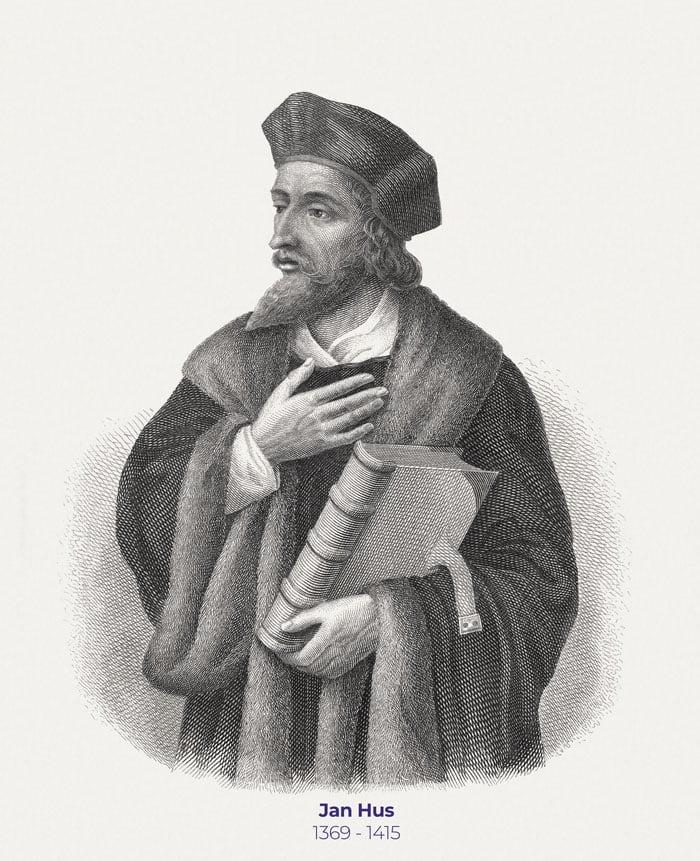
The roots of the Moravian Church go back to Jan (John) Hus (1369–1415), a Czech reformer burned at the stake at the Council of Constance in 1415. Forty years later a young man in Prague, named Gregory, grew dissatisfied with the lifestyle and worship of the major Hussite church. In 1457 he organized a community dedicated to living according to the Sermon on the Mount. They called their pacifist, communitarian body Jednota Bratrska, or “the Unity of the Brethren.” At times they used the Latin form, Unitas Fratrum (Unity of Brethren), which remains the official name of the Moravian Church. In 1467 the group established an independent episcopacy and clergy.
The next celebration of the Martyrdom of John Hus will be held at Home Moravian Church on Sunday, June 8, 2025, at 10:00 a.m. The service will include the Sacrament of Holy Communion.
The Moravian Church Began as an Intentional Christian Community
The Unity developed a distinctive and highly structured organization with a strict discipline. True to the Hussite Reformation, the Unity insisted on the necessity of giving the chalice to the laity and holding clergy accountable to Scripture and the community. The Unity also maintained the principle that the things essential for salvation are 1) the work of God in creation, redemption, and sanctification, and 2) the response in faith, love, and hope. Other things point to the essentials, such as Scripture, clergy, and so forth, but are not essential. Faith, they taught, is completed in love.
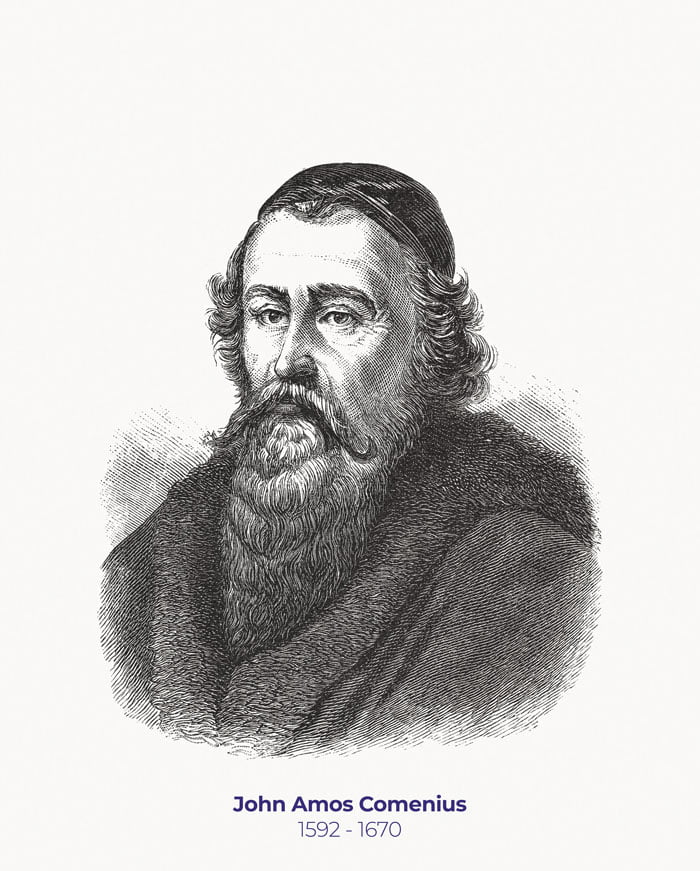
The second generation of the Unity moved away from its sectarian character and moderated its stance against swearing oaths and participating in civic government. When Martin Luther began the Reformation in Germany, the Unity sent students to Wittenberg and entered into the mainstream of Protestantism. The most prominent figure to emerge from the Unity was the brilliant Czech educator Jan Amos Comenius who revolutionized education and laid plans for a reformation of society in the 17th century. He was also a Moravian bishop and theologian. Persecution under the Hapsburgs almost exterminated the church in the 17th century.
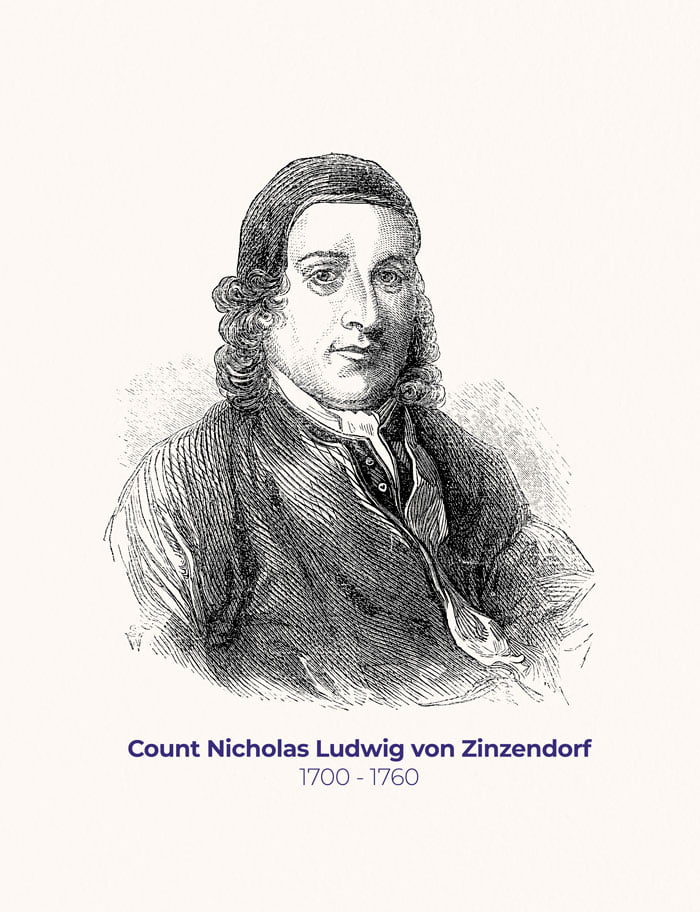
In 1722 a small group of Protestant refugees from Moravia settled on the estate of a Lutheran nobleman named Count Nicholas Ludwig von Zinzendorf (1700–60) in Saxony. There they built the town of Herrnhut. After a period of conflict and dissension, the community agreed to live by a Brotherly Agreement, and in celebration of their new-found sense of unity they shared in Holy Communion on August 13, 1727. That service marks the second founding of the Unitas Fratrum.
Herrnhut was an intentional Christian community in which there was daily worship and a unique social structure. The Moravians adopted several New Testament rituals including footwashing, the kiss of peace, and the agape meal. In the 18th century the church built over two dozen of similar communities including Bethlehem in Pennsylvania, Gracehill in Northern Ireland, and Christiansfeld in Denmark, which is a World Heritage Site.
With a Strong Missional Impulse, the Moravians Established Communities Around the World
The Moravians’ extensive mission enterprise began with work among enslaved Africans on St. Thomas in the Virgin Islands. In the 1730s the Moravians became the first church to ordain women of African descent as pastors and evangelists. The Moravians attempted to establish a settlement in Georgia in the 1730s, but the only lasting result of that work was the conversion of John Wesley (1703–1791) to “heart religion.” Permanent work was established in Pennsylvania and North Carolina in the 1740s and 1750s.
The Moravian evangelist David Zeisberger (1721–1808) had great success among the native tribes of the northern United States, but the indigenous Moravian church was virtually destroyed by the massacre of Moravian Indians at Gnaddenhutten, Ohio, in 1782 by an American militia. In the 19th century, the church evangelized German and Scandinavian immigrants in the upper Midwest and established the Western District. Recent growth in the United States comes mainly from immigration from Central America and the Caribbean, where the Moravians have long had a strong presence.
In 1753 the Moravians purchased almost 100,000 acres of land in North Carolina, where they established several farming villages and a central town called Salem. The congregation of Salem was officially established on November 13, 1771. In 1806 the congregation began meeting in the newly constructed church on the corner of Salem Square.
For half a century Salem followed the Herrnhut model of a “congregational town” in which single men and single women lived in separate communal dwellings called “choir houses.” There was no distinction between church and civic life, and all residents agreed to live according to a Brotherly Agreement that regulated religious, social, family, and economic affairs.
The communal structure of Salem eroded after the Revolutionary War, and in 1818 the church began to set aside some of its distinctive practices, including the kiss of peace. By 1850 the civic life of the town of Salem was separated from the religious life of the congregation.
In the late 1800s, Salem members worked to form Sunday schools in locations apart from Salem. Members of the Sunday schools often referred to Salem as “the Home church.” Eventually, the church in Salem came to be known as “Home Moravian Church.”
The Moravian Church is a Single Worldwide Body
There is only one Moravian Church worldwide, divided into over twenty governing units, called provinces. In 1957, the church embraced decolonization and adopted a new organization that granted autonomy to the former mission provinces around the world.
The highest administrative body in each province is the synod, which meets every four years to direct missionary, educational, and publishing work and to elect a Provincial Elders’ Conference, which functions between synod meetings. The Unity Synod for the worldwide church meets every seven years. Bishops, elected by provincial synods, are spiritual, not administrative, leaders of the church.
The major doctrinal statement of the church is The Ground of the Unity (1957, revised 1995), which emphasizes that the love of God was manifested in the life and death of Jesus. The church tries to follow the teachings and example of Christ as well as the inner testimony of the Holy Spirit in everyday affairs, including the pursuit of social justice. The Ground of the Unity affirms the Moravian understanding that ecumenism is a mark of true Christianity.
Home Moravian Church Established in Salem, November 13, 1771
The sanctuary building itself, with its distinctive belfry, was completed in 1800, to which the Rondthaler Building (named for a prominent bishop) was added years later. The Sanctuary underwent a major renovation in 1913. A Christian Education and Fellowship Hall building was built prior to World War II.
Salem was to be the industrial and administrative center for the Moravians in North Carolina. Its economy and nurturing groups would enable mission work to go forth to the Cherokees in northern Georgia and other peoples. Home Moravian Church established Sunday schools and worship places in many areas of what became Winston-Salem. Those became churches that are part of what is now called Salem Congregation.
Find much more history at Moravian.org.